Marble Master
- 4.5
- Rating
- 10.00M
- Installs
- Free
- Price
 Analysis by App-foxy
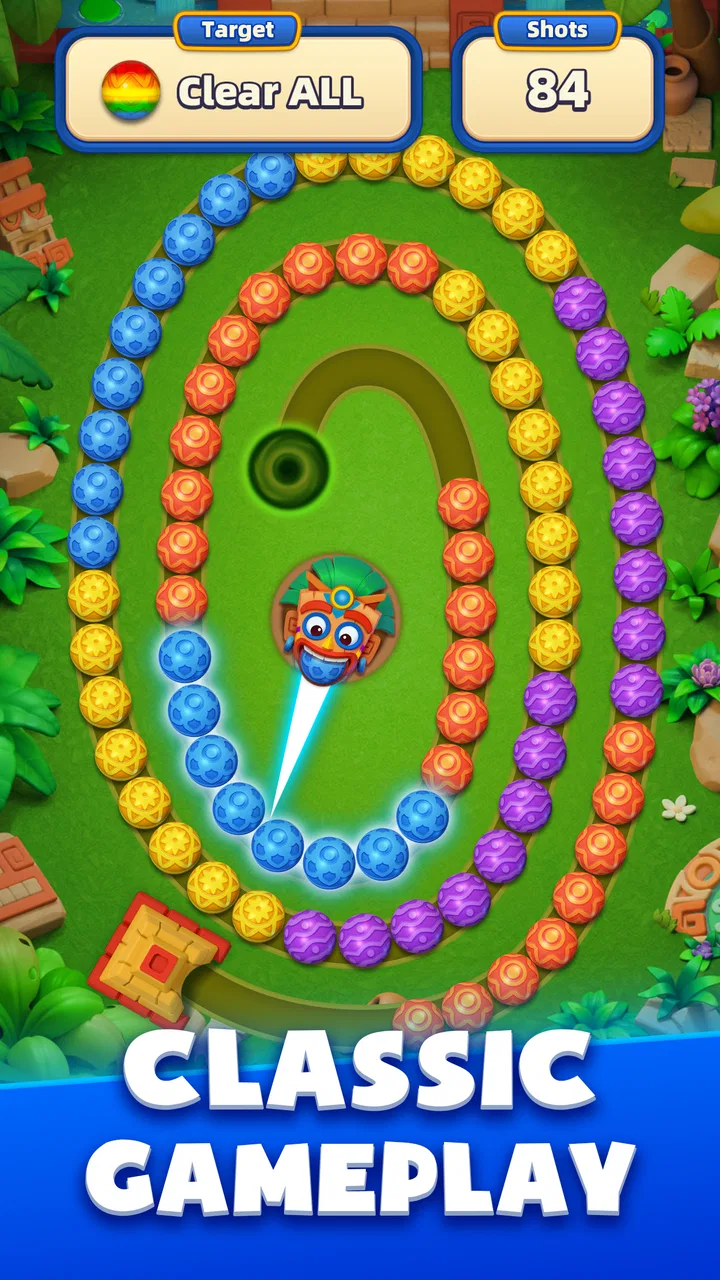
I found Marble Master easy to understand within a few minutes: marbles move through a colorful puzzle board, and I match or shoot them to clear groups before the layout becomes difficult to manage. That simple starting point is the game’s biggest strength. It does not ask me to learn a complicated control scheme or study a long story before playing. I can open it for a short break, solve a few boards, and put it away without losing the thread.
It is a free puzzle game from TEEWEE LIMITED, rated for Everyone. With an average rating of 4.5 from around 217 thousand ratings and more than 10 million installs, it has clearly reached a large audience. I would describe it as a casual matching game with a shooting element rather than a deep strategy title. The appeal comes from reading the board quickly, choosing a useful shot, and enjoying the satisfying chain reaction when several marbles disappear together.
How Marble Master works in everyday play
I find the best way to approach each board is to pause after a shot and reassess the whole arrangement, rather than aiming immediately at the most obvious group. That small habit helps me spot whether a clear match is also creating a useful opening for what comes next. It also makes the difference between a quick casual round and a more deliberate puzzle session easier to feel.
You May Also Like

 Blood Strike: 2.5 Anniversary
Blood Strike’s Loadouts Turn Every Drop Into a Tactical Gamble
A close look at Blood Strike’s custom loadouts: how fast access to signature weapons reshapes its battle royale rhythm, rewards preparation, and narrows the gap between fights.

 Pandora - Music & Podcasts
Pandora’s Music Is Easy to Start, but Harder to Recover
Pandora’s strength is its low-effort path from a seed to a station. Its weak spot is how much confidence it asks you to place in connection, setup, and quiet recovery.

 8 Ball Pool
 Is Built on Rivalries, Rematches, and Routine
A close look at the rivalries, rematches, shared routines, and unanswered safety questions that turn a quick pool match into a persistent mobile community.

 Samsung Music
’s Quiet Strength Is Playing What You Already Own
Its reach comes less from spectacle than from dependable access to a personal library. That simplicity is both the app’s strongest retention engine and its ceiling.

 AccuWeather: Weather Radar
AccuWeather Review: A Quick, Clear Forecast for Everyday Decisions
For everyday plans, the best forecast is the one you can understand quickly. AccuWeather makes rain timing, radar, and local conditions easy to act on, with a few trade-offs.

 Hill Climb Racing
Why Hill Climb Racing Still Turns Crashes Into One More Run
A tiny car, a bumpy hill and one more upgrade: Hill Climb Racing keeps resurfacing because its simple chaos makes every near-miss feel personal.
More From Our News Desk
View All News


Readable goals and straightforward navigation
The basic objective is clear enough for a first-time player: match marbles, shoot them into place, and create blasts. I never felt that the game needed a separate explanation before I could try a level. The visual arrangement does much of the teaching. A player can usually understand where the current marble is going, which colors are close to forming a group, and which part of the path deserves attention.
That clarity matters for people who prefer games with low mental overhead. I can play while waiting for an appointment or during a short commute without having to remember a large inventory, a complicated map, or several different menus. The game’s category is puzzle, but its rhythm is more immediate than a traditional logic puzzle. It rewards quick visual decisions as much as careful planning.
The interface also suits players who do not enjoy reading large amounts of text. The action is communicated mainly through the board, the marbles, and the result of each shot. For someone who finds text-heavy games tiring, that is a useful advantage. At the same time, a visual design built around colored pieces can create its own difficulty, especially when several shades are close together or when the board becomes busy.
I recommend beginning with a relaxed pace instead of immediately trying to clear every possible group. The first useful habit is to look beyond the next match. A shot that removes a small group may be less valuable than one that opens a path or leaves a better color arrangement for the following move. This makes the game feel less like random tapping and more like a small sequence of decisions.
Why the shooting mechanic changes the puzzle
Many matching games let me swap neighboring pieces or drag items into a fixed position. Here, the shooting action gives the board a different kind of tension. I need to consider both the color I am using and the place where it will land. A good shot can connect separated groups, while a rushed shot can make the next decision harder.
This is one of the more interesting details for players who have already tried ordinary match-three games. The challenge is not only recognizing a match; it is judging an angle, a gap, and the timing of the board. I find that this creates a more active feeling than simply exchanging two tiles. It also means that mistakes can feel more personal, because I usually know whether I fired too early or aimed at the wrong opening.
One practical approach is to use the edges of the board as temporary storage when the layout allows it. I try not to fill every available space with immediate matches. Keeping a little room can make a later shot easier and reduce the chance of being forced into an awkward color. This is not a guaranteed solution for every board, but it is a useful way to avoid playing only one move at a time.
Visual comfort, color recognition, and sensory load
The game’s colorful presentation helps me identify the main action quickly, but it also places real demands on vision. Players who distinguish colors easily will probably understand the board at a glance. Players with color-vision differences may need more time when two marbles have similar tones or when effects appear during a chain reaction. I would not treat the game as automatically comfortable for every visual ability simply because the goal is simple.
For better readability, I find it helps to pause mentally after each shot and inspect the new arrangement before firing again. Watching the whole board during a fast sequence can be tiring, particularly on a smaller phone. A larger screen may make the path and clusters easier to follow, although the game remains designed for mobile play rather than for a large display.
The visual feedback is part of the reward. Clearing a group gives the action a lively, responsive feel, which is useful for players who like immediate confirmation. However, anyone sensitive to bright motion, rapid changes, or busy effects may prefer shorter sessions. I would be cautious about recommending it as a calming game for every player; the matching is relaxing when the board is under control, but pressure can build when pieces approach an inconvenient position.
Sound is another personal consideration. I often play casual puzzle games with audio reduced or disabled, especially in public places, and this type of game remains understandable when I focus on the board. That makes it workable for quiet settings. Still, players who depend on audio cues rather than visual cues may find the experience less informative, because the core decisions are presented visually.
Touch control and motor demands
The main physical demand is accurate touch input. A player needs to direct a shot toward the intended gap or group, and small differences in finger placement can change the result. I found the control approachable, but it is not completely free of precision requirements. Someone with limited dexterity, tremor, or difficulty holding a phone steady may experience more failed shots than another player.
A useful adaptation is to hold the phone in a stable position and use one deliberate movement instead of repeatedly correcting the aim. I also prefer playing with the device supported on a table when a board becomes demanding. That simple change reduces hand movement and makes it easier to inspect the whole screen before acting.
The game is better suited to one-finger play than to games that require simultaneous taps, rapid swipes, or complicated combinations. That lowers the physical barrier for many casual players. It does not remove the need for timing and accuracy, though. If your ideal puzzle game lets you solve everything through slow, precise taps with no penalty for movement, a non-shooting logic game may be a better fit.
Short sessions are also helpful for motor comfort. I would not keep repeating a difficult board with increasingly tense movements. Taking a break can prevent the game from turning a small control challenge into frustration. This is especially relevant for younger players, older players, or anyone using a phone with a smaller touch target than they prefer.
Where it fits into real situations
I see Marble Master working particularly well in small pockets of time. Imagine waiting for a coffee order: I can play a board, stop when the order is ready, and return later without needing a long uninterrupted session. The same applies to a quiet break at home or a short wait before an appointment. Its quick visual premise is more convenient in those moments than a story game that expects sustained attention.
It can also be a reasonable shared choice for a family with different gaming habits. A child can understand the matching idea, while an adult can enjoy planning better shots. The Everyone age rating makes it broadly approachable, although adults should still consider whether the visual intensity and in-app purchase options suit the particular child using the device.
For travel, the game’s compact puzzle format is appealing, but I would not assume that every situation will be ideal. A moving vehicle, poor lighting, or frequent interruptions can make accurate aiming harder. If you are prone to motion discomfort, looking closely at a moving board may not be pleasant. In those circumstances, an audio-led game or a slower text puzzle could be more comfortable.
It is also worth thinking about attention. The game is easy to start, but a difficult board can encourage “one more try” behavior. I use a simple limit: I stop after a few unsuccessful attempts rather than letting a short break become an extended session. That is not a flaw unique to this title, but the quick restart-and-try-again structure can make time pass unnoticed.
Progression, spending, and practical expectations
The free price makes it easy to try without an upfront commitment. There are in-app purchases ranging from $0.99 to $99.99 per item, so I would review the purchase controls before handing the phone to a child. The presence of optional spending does not determine whether the basic game is enjoyable, but it does affect how I would set up a family device.
I prefer treating purchases as optional rather than as part of the normal cost of playing. If you are comfortable with a free-to-start puzzle game and can ignore offers, the entry point is convenient. If you strongly prefer a one-time purchase with no purchase prompts or monetization decisions, a paid puzzle alternative may feel cleaner even if its initial price is higher.
The current version is 16.602.260, and the game supports devices running Android 6.0 or later. That makes it accessible to people who do not own a recent phone, provided their device meets that operating-system requirement. On older hardware, I would still judge the experience by actual responsiveness and screen size rather than by the system requirement alone. Accurate shooting is more enjoyable when the display responds consistently.
The developer, TEEWEE LIMITED, has built the experience around a familiar idea with a more active control style. I would not approach it expecting a narrative campaign, a competitive strategy simulator, or a quiet brain-training tool. Its value is in repeatable board solving, quick feedback, and the small satisfaction of finding a better shot than the obvious one.
Barriers that may change the recommendation
The largest barrier is visual dependence. If you have trouble separating similar colors, the game may require extra effort, and that effort can become more noticeable as the board fills. I would try the opening play carefully rather than relying on the general Everyone rating as proof that the presentation will work for every player.
Precision is the second important barrier. One-finger control is simpler than multi-touch play, but the player still needs to aim. If your hands shake, your touch accuracy varies, or you use a very small screen, the game may feel less fair than a turn-based puzzle with fixed selections. Playing with the phone supported can help, but it cannot remove the underlying aiming requirement.
There is also a concentration barrier. The rules are simple, yet good play becomes less casual when I start planning several shots ahead. That is a strength for players who want a little strategy, but it may disappoint someone looking for a completely passive distraction. The game asks me to watch the board and accept that a careless move can make the next one worse.
Finally, the free model may not suit everyone. The broad price range for individual in-app purchases means families should use the device’s purchase protections and decide in advance whether spending is allowed. For adults who simply want a no-cost pastime, this is manageable. For anyone seeking a fully predictable, purchase-free experience, it is worth choosing a different format.
How it compares with familiar puzzle alternatives
Compared with a standard match-three game, Marble Master feels more physical because the shot itself matters. I get more control over where a marble enters the arrangement, but I also carry more responsibility for the result. A match-three title may be easier for someone who prefers fixed swaps and a slower visual decision. This game is better for someone who enjoys aiming and watching a chain develop from one placement.
Compared with a pure logic puzzle, it is less abstract and more immediately rewarding. I do not need to write down clues or hold a long set of rules in my head. On the other hand, it may offer less satisfaction to players who want a single complex problem with a clearly provable solution. The appeal here is repeated short decisions rather than deep deduction.
Compared with an endless arcade game, the marble format gives me more time to think. It is not as dependent on rapid reflexes, although the board can still create pressure. That middle ground is why I think it suits casual players who want some action without committing to a demanding action game.
My inclusive verdict
I recommend Marble Master to players who want a colorful, easy-to-start puzzle game that rewards better aiming and forward planning. It works especially well for short breaks, casual family play, and people who enjoy matching games but want more control than a simple tile swap provides. The free entry point and broad age rating make trying it straightforward, while its Android 6.0 support keeps it relevant for some older devices.
I would be more selective if visual color separation, precise touch control, motion, or purchase prompts are concerns. The game is approachable, but approachable is not the same as universally comfortable. A slower logic puzzle may be better for players who need fully deliberate input, and a paid alternative may be preferable for people who want a fixed cost.
My final impression is positive because the central action is clear and satisfying without pretending to be more complicated than it is. The best way to play is to keep the phone steady, scan the whole board before shooting, preserve useful space, and treat short sessions as a feature rather than a limitation. If you want a simple marble puzzle with a real aiming decision behind every move, this is worth trying; if you need minimal visual or motor demand, choose a gentler puzzle format instead.
With its 4.5 average, large player base, and free starting point, it has enough evidence of broad appeal to deserve a place on a casual gaming shortlist. I would install it for quick, colorful problem-solving rather than for a long-form adventure. That distinction is important, but within its lane, Marble Master delivers a pleasant balance of readable rules, active touch play, and small strategic choices.
FAQs for Marble Master
01What is Marble Master, and how is the game played?
Marble Master is a casual marble-shooting puzzle game in which you aim and launch colored balls to create matching groups and clear them from the board. The basic controls are easy to learn, but later stages require careful timing, accurate aiming, and smart use of special power-ups. It is designed for short play sessions while still offering progressively more challenging levels.
02Is Marble Master free to download and play?
Marble Master can generally be downloaded and played for free, allowing users to access the main gameplay without paying upfront. However, the game may include optional in-app purchases for coins, boosters, extra lives, or other helpful items. Advertisements may also appear between levels or after certain actions, so the overall experience can vary depending on how often you choose to use optional purchases.
03Does Marble Master require an internet connection?
Many of Marble Master’s core levels can usually be played without a constant internet connection, which makes the game convenient for travel, commuting, or offline entertainment. Nevertheless, an internet connection may be needed for advertisements, cloud-related features, updates, special events, or in-app purchases. Availability of offline functionality can also differ between versions and devices.
04Is Marble Master suitable for children and casual players?
Marble Master is generally easy to understand and suitable for casual players because its controls are simple and the objective is clearly explained. Younger users may also enjoy the colorful graphics and straightforward matching mechanics. Parents should still review the game’s age rating, advertising, and in-app purchase settings, since optional purchases or promotional content may be available depending on the platform.
05What should I know about Marble Master before downloading it?
Before downloading Marble Master, expect a relaxing but increasingly demanding puzzle experience based on aiming, matching, and clearing marbles. The game is a good choice if you enjoy quick levels and familiar match-based mechanics, but repeated advertisements, limited lives, or purchase prompts may affect your experience. Check your device’s storage, supported operating system, privacy information, and the latest store reviews before installing.
Pros
- Simple controls make it easy to start playing immediately.
- Short levels are convenient for quick gaming sessions.
- Colorful marble effects make the gameplay visually appealing.
- Progressive challenges help maintain interest over time.
- Works well for players who enjoy casual puzzle games.
Cons
- Some levels may feel repetitive after extended play.
- Difficulty can increase suddenly in later stages.
- Frequent ads may interrupt the gameplay experience.
- Limited variety may reduce long-term replay value.
- Some upgrades or bonuses may require in-app purchases.

Marble Master
Gallery